
Lunch at Fernando’s in Macau
Monday, March 26
8:00 – At Don Muang airport. It is entirely too early and we have been here an hour already. But it’s worth it: for some reason, the Asia’s 50 Best people have invited us to Macau to attend the big ceremony on Tuesday at Wynn Palace Cotai. I am not being unnecessarily humble. Literally no one we have dealt with has heard of “Bangkok Glutton” before. But they already sent me the invite and can’t take it back. Sucks for them!
9:00 – We start our big foodie weekend with a double sausage McMuffin set (Karen) and double Filet-O-Fish (me). Karen gets McDonald’s coffee and instantly regrets it.
14.00 – We have arrived at the Wynn Palace, having taken a taxi for the entire 5 minutes it takes to get there from the airport. Already, people are extremely nice and efficient. Check-in service congratulates me on being ready with my registration number. I feel smart and special. They take us to our room, and it has a great big view of the airport that we just left, as well as a ginormous bathroom. Karen and I are both thrilled.
14.20 – We register at the media center, while a nice man named Bruno opens three bottles of water that Karen keeps rejecting because she thinks they were already opened before Bruno opened them. I (yet again) request an interview with Chef Bee Satongun of Paste (Asia’s Top 50 Female Chef of the Year), because I earlier received an email from Asia’s 50 Best PR rejecting my interview request, telling me that I can just reach out to her at the event (where 840 people will be). Why include her on the list of people to request interviews from then? This is just a way to tell me to fuck off, right? (“Haha,” says Karen. “The next time someone pisses me off, I can tell them to reach out to me at the event.”)
15.00 – Work worries aside, our stomachs beckon, because it’s been ages since we ate our McDonald’s breakfast. With “Everybody Wang Chung Tonight” blaring in the background, we take a taxi to Fernando’s, which I love as a great example of the Portuguese-Chinese fusion they call “Macau cuisine”. We get almost everything that we’re supposed to, like the suckling pig, bacalao fritters, and clams, but forego the fried rice and the gorgeous-looking salad with thick, huge slices of tomato.

Fernando’s’s caldo verde
17.00 – We get back in time to get ready for dinner in two hours. We are absolutely zero percent hungry. But before we retire to our room, we take the free gondola that passes in front of the hotel complex and which offers a bird’s eye view of the property, including the preparations for tomorrow’s Asia’s 50 Best Restaurants party by the pool. Amped up by our gondola trip, I buy a pair of kitten heels from Gucci.
19.00 – Totally on time at SW Steakhouse, but we forgot our press passes, so the front desk is unsure of whether we are legitimate freeloaders or not. Once we get through (I am in the system as “Mr. Chawadee Nualkhair”), we get a nice table that for some reason seats us directly next to each other, with a view of the Chinese-panelled wall in front of us. We find out why exactly 30 minutes later, when the lights dim, the panels part, and we are treated to a mini-show featuring a giant gorilla figure and a banana. Karen thinks it has a very Disney feel. Every 30 minutes, a new mini-show comes on. My mom would love this.
SW (the initials of Wynn Resort founder Steve Wynn, who has since stepped down from the company) has smartly taken the decision of what to order out of our hands, and is providing us with a four-course menu complete with wine pairings. It’s great and smart, and the wines are fabulous — not a stretch considering the huge walk-in wine fridge, outfitted with 2000 bottles bearing 500 labels and maintained at the optimal temperature of 16 degrees Celsius (7-8 degrees for the champagne, stocked in mini-fridges within the fridge). Unfortunately, Karen and I are not hungry. Like, at all.

All the same, William, the restaurant’s general manager, comes up and gamely attempts to guide us through the menu, which includes a Tuscan kale salad (a product of Steve Wynn’s stint as a vegan, William tells us), a Maryland-style crab cake generously spiked with Old Bay Seasoning, and an American Wagyu-Angus sirloin from Idaho, cooked perfectly medium-rare and bearing the sort of char one would find on Texas-style barbecue. Both William and L.A.-born chef Burton Li tell us that they are spreading the gospel of American-style steak to the Chinese, and that the Chinese are gradually responding. With us, they are preaching to the choir.
Tuesday, March 27
7.34 – I wake up late, having expected to run first thing in the morning, but being thwarted by the very effective blackout drapes, which make you think it is perpetually 3 in the morning. I am supposed to do the Wynn Palace Property Tour at 10 in the morning, but Karen decides to do it on her own so that I can finally run — something I am desperate to do after the copious amounts of food and wine at Fernando’s and SW Steakhouse. Overeating is no walk in the park, yo.
8.30 – Before we leave, though, we have breakfast in our room: healthy egg white omelet with fruit (Karen) and hard-boiled eggs with bacon, sausage and croissants (moi). Not surprisingly, we are rapidly feeling stuffed again.
10.00 – I run, finally. A note on music at the gym: Alan Parsons Project and Air Supply are probably nice when it’s late at night and you are six years old and your dad is driving you home from a Chinese restaurant in Cleveland, but it does not get you very pumped up. Instead, I entertain myself with video that Karen has taken of a phoenix bursting out of a flower-decked egg. During the tour she learns that every single blossom on the premises is real, sprayed with a material that lets it last up to a year and a half (!)
11.30 – I am showered and sitting in front of my laptop in an empty room. Where TF is Karen?
11.45 – Karen arrives, having made friends with absolutely every single person on her property tour, including Aron, the tour guide and Karen’s new boyfriend.
12.15 – We go downstairs to what we think is our reservation at Mizumi, the Japanese outlet at the hotel. We learn — gradually, after much prompting, because the lovely receptionist is afraid to tell us we are wrong — that we are at the wrong Mizumi, and are supposed to take a 15-minute shuttle to Wynn Macau, where our reservation at the two Michelin-starred Mizumi awaits. Aron walks us to the shuttle to make sure we find it.
13.00 – We are really glad to have been ushered off the premises of our hotel and brought here. We are being treated to a very long and rambling sushi omakase course that includes fresh hairy crab, ungodly amounts of uni and fatty tuna belly, plus as much Blanc de Blancs and sake as we want. “Is that OK with you?” the waiter actually asks us. We laugh.

Our abalone and uni soup
People use the word “decadent” frequently, but this is truly it, with all that that means: copious lashings of tuna, and uni on everything, even on fatty tuna, rolled in a buttery slice of hamachi, and in a hot clear soup with slices of abalone. We eat everything, obviously. Karen announces to our surprised sushi chef that she loves it here and will never leave.

Botan ebi nigiri
15.00 – I have nothing to do, since my request for an interview with Chef Bee — including a last-ditch Instagram DM before bed last night — was rejected. Laden with alcohol and with an entire school of fish in my belly, I succumb to sleep.
17.45 – Crap. It’s time to get ready for the cocktail ceremony, which starts in 15 minutes.
18.00 – The cocktail party (and the post-ceremony party) is held poolside, which makes me wonder if they expect people to get sloshed enough to jump into the water. But with the Cotai skyline, such as it is, spread out in front of us, and the gondolas that whizz over our heads, the smiling waiters offering glasses of wine and canapés and the odd, pulsing club music, it really does feel … very nice. It’s a nice party. And of course, William is here, like the genie in “Aladdin”, showing Karen the sake bar and offering to fetch me a glass of wine despite the fact there are about 8,000 other people here. This man is really good at his job.
My dream of interviewing Chef Bee shattered, I do manage to buttonhole Chef Ton of Le Du at the bar, pestering him to answer my email by Friday. “Thank you,” he says, which I think is a classy way of saying “You can leave me alone now.” Later, Karen bumps into Chef Ian Kittichai and congratulates him on his excellent Instagram feed. He takes the compliment graciously, especially for a man in a crowded elevator. And that is the extent of our pleb-chef interaction for the evening. Hey, at least I got a pair of shoes out of this trip.
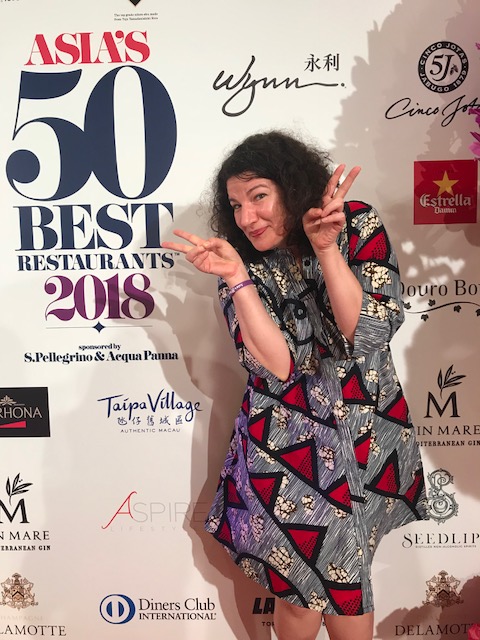
Karen woke up like this
20.00 – We are gently encouraged to attend the ceremony by a young man bearing a mini-xylophone and innumerable food and drink waiters, who tell us they cannot serve us anymore. I manage to cajole someone into giving me a glass of red wine, which I suspect was taken off of a clean-up tray. I later regret it when someone makes me down the entire glass on the red carpet before being allowed into the ceremony room.
10.00 – Congratulations everyone! I am told that the ceremony was finished in record time. The merits of the restaurants themselves and the fairness of their rankings versus Michelin’s (and personally, the striking dearth of female chefs), well, that’s debating material for somewhere else. Ultimately, what these lists and stars do is spur chefs to work harder and customers to explore more places, and in the end, doesn’t everyone end up winning?
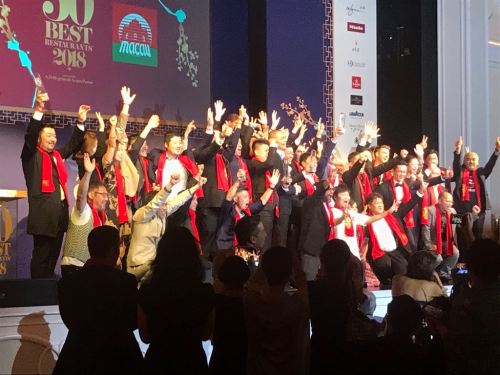
Congrats you crazy kids




 Bangkok Glutton