When food is the enemy

chicken2

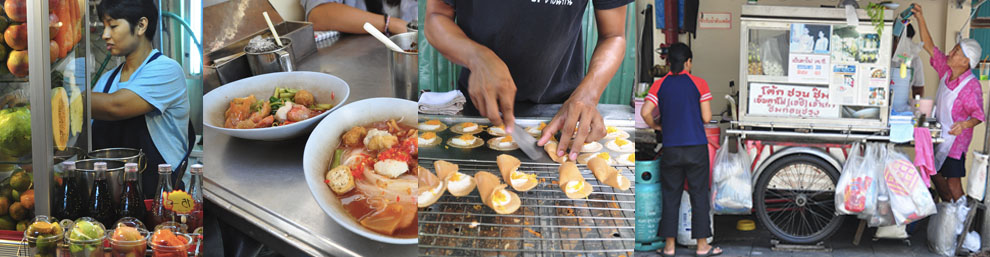
Chicken rice at Nai Thong

It started with the insomnia. Sleeping two, maybe three hours a night, only to wake up to a still-dark room and a dispiriting “2:00” or even “12:30” on the clock. I started binging on sleep products. I did acupuncture, reiki, kinesiology, any treatment that could possibly help. My days went on like before. But I began dreading the sunset and the sinking feeling of disappointment that awaited me every time I opened my eyes. It wasn’t until I had a panic attack at my friend’s Thanksgiving party when I started thinking that there could be something really wrong.

It was, of course, psychological. I was diagnosed with anxiety and depression and put on Prozac. But my parents always suspected it could be something else — something hormonal. Something like menopause. I mean, once you head down that avenue, why not go all the way? So I met with a doctor in Bangkok Hospital Chinatown who took vials of my blood, sent away to Germany to be analyzed for whatever it was that could be making me batshit crazy.

I went away to the States to stuff myself with spinach-artichoke dip, tub-sized salads doused in blue cheese dressing, hamburgers capable of feeding a family of four and enough Buffalo wings to sink a miniature Titanic. This turned out to be a good decision. Because when I came back, Dr. Tanupol — spry, slim, blessed with the skin of a 10-year-old — told me that not only did I have an overactive adrenal gland and a creaky thyroid working at 50 percent capacity … but that I was also cursed with a host of food allergies that even Gwyneth Paltrow could be jealous of.

The list, helpfully alphabetized for my convenience, is long and even more insane than I am. Gluten, wheat, rye, barley, oats, spelt, wild rice. Cow’s milk, goat’s milk, sheep’s milk, and mare’s milk. Almond, asparagus, cashew nut, plaice. Eggs. Coconut and cherry. Heartbreakingly, mustard seed. I was to try to stay away from these items for six full months, until my body readjusted to the new battery of supplements he would prescribe me, to be taken daily and nightly, the hero to my wack wimmin’s issues because wimmin always be going cray. Only after six months could I be retested to see if I could really eat again. “You are Asian. You should just eat Asian food,” he said, forgetting that there is egg or coconut milk in almost everything worth eating.

Let’s be real: there is no way I can stay on this diet. Because PIZZA. PASTA. PIE. OTHER FOODS THAT DON’T BEGIN WITH P. Watching other people eat the food I want to eat is an interesting exercise in vicarious experience, aspirational living, and envy tempering. Like meditation, it’s a good mental exercise. At least that is what I tell myself.

So what to I do until then? Of all the street food that I could be eating, chicken rice falls squarely onto the top tier of things that I love (yes I know that soy sauce has gluten, but in the words of Donald Trump, give me a break). It’s a  Chinese-inspired street food dish found all over Asia, but no one quite does it like Thailand: the gingery, chili-spiked sauce, the fatty sheen on the rice, the tender hunks of poached chicken, the gleaming cube of blood. And the soup — it’s the soup, nowadays, that seems to set Thai chicken rice apart. Making a soup that will blow your socks off is the new black, and far easier than inventing yet another sauce to serve atop your chicken rice.

At Nai Thong (982/30 Soi Sathupradit 58, 02-682-4253, branch on Soi Soonvijai, 02-716-5664) the soup is a bracing, aromatic splash of lemon, grounded with a simmered slice of winter melon. It’s a soup eager to claim all the attention for itself, not content to play second fiddle to some tranches of boiled poultry. This would normally be annoying to me, because I delight in being annoyed by things. But not today. Not right now.

chicken1


2 Comments

Filed under Uncategorized

Glutton Abroad(-ish): Fusionality

beef

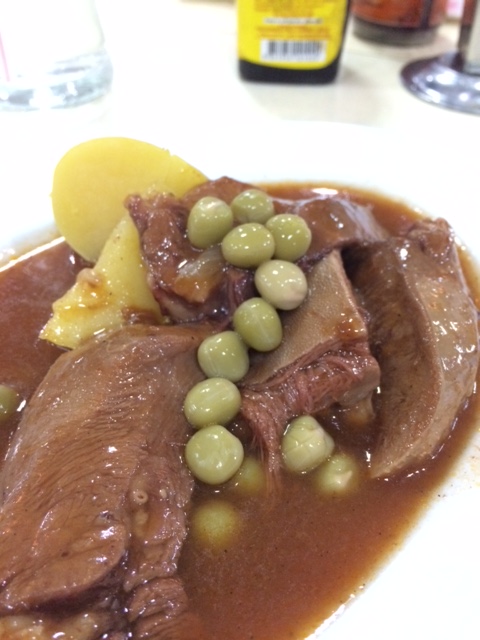
Beef tongue stew at Pattakarn Ahgawe (Fu Mui Gee 2)

It’s become trendy in recent years to deride fusion, especially in Asia. This is probably because this region arguably plays victim to the greatest number of fusion-related culinary crimes in recent memory. Many diners are still old enough to remember the global fusion experiments of the 1980s, the jumble of Middle Eastern, Asian, European and what-have-you influences combined with the judiciousness of a Donald Trump backstage at a beauty pageant. With all its flavor bells and whistles, of course, Thai food was an ideal target. Many, many bad dishes resulted. It gave fusion a bad name, making its adherents look like fad-obsessed school kids doodling “Mrs. Green Curry Pizza” on their Trapper Keepers, forever too earnest, always trying too hard.

Things have swung the other way, where the pedigree of a dish is celebrated and the best recipe bloodlines harken back several generations (but not too far that the Chinese influence is gone and the dish is a tasteless mess). It’s in vogue to point out when dishes veer from the prescribed conventional wisdom, and (in Thailand at least) subject every restaurant with even middling pretensions to a test of ideological purity worthy of any Bernie bro. That’s not to say that this is coming out of nowhere; the government, if all those stories of tasting robots are to be believed, is in on it too. In an attempt to control how things taste, there is now an official way to cook things, an exercise as useful — and ultimately, auspicious — as my quest to lose 10 pounds.

I was thinking of this while eating kimchi quesadillas and short-rib tacos drizzled in a chili-soy vinaigrette at Kogi BBQ in LA, an example of the type of fusion food people hate, except when they love it, because it tastes so good. Yes, a Korean and Mexican melange sounds like the very worst sort of foodie fever dream, a mishmash of two Southern Californian-favored cuisines that seem to have only “Hey, we’re not white” in common. Who knew it could be this delicious?

quesadilla.JPG

Kogi kimchi quesadilla

Later on, in Sonoma, I dined on a heaping big plate of avocado chaat (cubed ripe avocado piled over potato and lashed with tamarind sauce and coriander chutney), kale pakoras and naan layered with ripe cherry, cheese and coriander at a restaurant called “Delhi Belly” — I know! I know that it sounds terrible! Do not scorn me, Bernie bro! But I enjoyed myself regardless, because that weirdness was something we would never see anywhere else. It was uniquely American and, so, covetable.

When asked at a dinner party once what my favorite Thai restaurant was, I said that it was Silom Pattakarn (which has since moved). The person laughed. “That’s not even Thai food,” he said. Which is true. It is an Asian translation of Western favorites, made with Asian ingredients and Asian cooking techniques. According to Chef McDang, this type of cooking might have originated in the court of Rama IV, who hired many Chinese cooks to create a menu of “Western” dishes for visiting dignitaries. This type of menu is now replicated by a (rapidly dwindling) stable of Chinese-Thai restaurants that sprouted up in the wake of World War II and introduced a new generation of Bangkokians to the West via this Chinese-Thai-European fusion. The dishes that all of these places had in common: beef tongue stew, steak salad, and an Anglo-Indian chicken “curry” that, on occasion, would be served with slices of toasted white bread.

I don’t know where Silom Pattakarn is now, so in its absence, I go to Pattakarn Agawe, located on Rama IX Soi 7 off of Rama IX Road (romanization is tricky for Thai words so it could also be Agave, Akaway, what have you). The beef tongue stew is the best I’ve had, but everything else is pretty good too. Just think: even though it’s the fusion that someone undoubtedly railed against those many years ago, today it’s still considered delicious enough to put into a category all its own.

curry.JPG

Chicken curry with a cucumber-shallot-chili relish


5 Comments

Filed under Uncategorized

Beauty contest

suki.JPG

Dry suki and sauce at Manop Sukiyaki

I know it’s not very cool of me, but I don’t like to watch Woody Allen films. It always ends up (excuse my French) pissing me off. This is just the stuff on the screen that I’m talking about, not even his personal life. Watching Husbands and Wives was downright excruciating.

Call me shallow, but I just can’t get past the fact — especially with the mid-career Woody Allen stuff — that he got away with casting himself as a romantic lead in most of these movies. Even in the Annie Hall era, this requires more suspension of disbelief than I am capable of exerting. His movies require that you believe this man — who is constantly complaining, who always needs taken care of, who weighs less than me — is capable of drawing beautiful, frequently younger women to his side. Wassup with that? All those dry, pursed-lip onscreen kisses he has forced us to endure all of these years, like watching someone finish off a chicken wing while still trying to keep their lipgloss intact grossgrossgrossgrossGROSS. I mean, are all these women blind? And deaf? Juliette Lewis, what are you doing? Come on Diane Keaton, you got other options, gurl! Julia Roberts … well, ok, it already looks like she’s thinking of throwing herself into the Grand Canal. Just go ahead and do it, honey. Maybe a gondolier will sweep by and rescue you. I’d take my chances.

Of course, I can say this now, before my husband leaves me for a 24-year-old. I know this is the likeliest post-breakup option for him, because he has actually told me, to my face (“I won’t lie. I would go younger.”) Meanwhile, we live in a world where I would be forced to marry an octogenarian with (hopefully for him) impaired hearing because I have no marketable skills of my own. We could watch tennis and talk or not talk about soup all day. Maybe Woody Allen will be available by then and I will be forced to eat my own words. But who am I kidding? Woody Allen could get a 24-year-old if he wanted to, too.

I can’t say I’m the only shallow one around. People use appearance to figure out what food they want to eat, too. It shows in their choices: grilling chicken or fish, smoking on the grill or glowing white on the skewer over charcoal. Fresh chunks of mango piled sloppily over grains of rice glistening with coconut milk. Steaming noodles in broth with fish meatballs or a splash of bright pink fermented tofu sauce. It’s not hard to figure out why you would want to eat this stuff.

Unfortunately, the pleasures of Thai sukiyaki — adapted from the Japanese noodle dish but even more slatternly, sloppier — are not readily apparent. Ordered dry (hang), it’s a mess on the plate, a mixed-up melange of glass noodles, egg, green onion and whatever protein you’ve opted for, pork or chicken, beef or seafood. Even with broth (nam), it’s like Asian ribollita, an indiscriminate stew that suggests instead of shows. Yet the best versions of this dish make you forget that it’s a mess. Like a lot of Thai street food, the secret lies in the sauce.

At Manop Sukiyaki Rod Kraba (622 Soi Charoen Krung 27, 02-332-5516), suki is king, and the sauce (based on fermented tofu, spiked heavily with chilies) is the queen that made it all possible. Sure, there are dishes like guaythiew kua gai (chicken-fried noodles) and roast pork (chewy during rainy season because of the increased humidity), but they assume you are there for the suki. From 6 in the evening on, the back of a truck turns into a kitchen capable of churning out some of the best suki in the Chinatown area. The location is similarly as homely as the dish: an otherwise-abandoned alleyway with the occasional cat or cockroach. But unless you are absolutely sure this dish is the Woody Allen to your Mia, don’t turn back, don’t be deceived. You might be pleasantly surprised.

condiments.JPG


4 Comments

Filed under Uncategorized