Glutton Abroad: Dining on our own in Vietnam

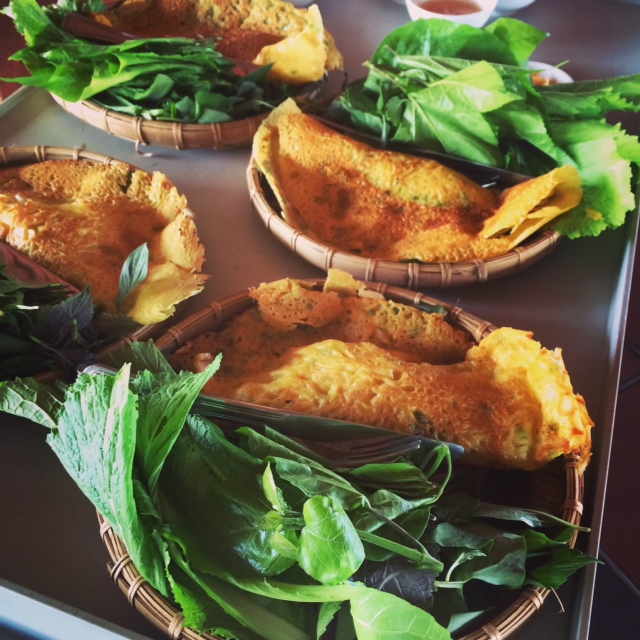
Banh xeo, or stuffed Vietnamese crepe, named after the sound the batter makes when dropped in the pan

Banh xeo, or stuffed Vietnamese crepe, named after the sound the batter makes when dropped in the pan

There is nothing Thai people understand less than the desire to be alone. When someone slopes off, declaring an interest in taking a solitary walk or — heaven forbid! — a meal alone, the obvious conclusion that most Thais will draw is that there is something wrong. Because there is nothing worse than being on your own, with nothing but your thoughts for company. There is strength in the collective “we”. In the solitary “I”, there is just you.

The tendency to leave ingredients unadorned is another thing that Thais would rather not do. Sure, there are the raw vegetables that go with salads or dips, but they are the supporting players, the antidotes to things that need balancing in the ultimate battle for harmony on your palate. But everything is just that: a force to be counteracted. Everything is meant to be manipulated for the greater good, no stray acacia leaf or shrimp paste ball left to its own devices. What would fish meatball want to go off on her own for, anyway? Who does fish meatball think she is?

This is what makes Vietnamese food so interesting to me. There is the furious jumble of salads where lightly blanched slices of beef vie with pickled onions and julienned bits of carrot and glass vermicelli, and soup noodles heaped high with greens and christened with a bit of fish sauce and a dash of lime juice. But it’s just that — a mix that comes apart in the mouth, free to remain carrots and coriander leaves and noodles despite being part of a dish, readily identifiable and unobscured by a paste marinade or egg netting or any other highfalutin culinary trick seeking to meld every component of the dish to some higher ideal.

A typical bowl of pho with maybe a few more chilies than usual

A typical bowl of pho 

And then there is the issue with the chilies: ultimately why I think Vietnamese food resonates with so many people in a way that Thai doesn’t. There isn’t the cloud of chilies literally obscuring your tastebuds. Vietnamese food isn’t a food-based “Fear Factor” where you are expected to endure varying levels of pain in the pursuit of eating like a local. It’s just there, a similar mix of textures and sweet, salty and sour tastes, but presented much more simply and accessibly. As Karen says, it’s “gently flavored”.

I think this sort of laissez-faire attitude is exemplified most by Ho Chi Minh City’s “Lunch Lady” (Nguyen Thi Tranh, Phuong Da Cao, District 1), who cooks something different for lunch every day and still has no problem expecting people to come to her streetside stall for a bite. In Thailand, where people are so hospitable it can become an affliction, there would inevitably be the worry that people might not like what you are cooking that day. Here, the attitude is, “This is what I’m cooking. You can take it or leave it.” Paradoxically, diners appear delighted to be told what to eat. These are the same diners that probably enjoy being yelled at by irate Asian ladies. Future street food cooks, mull a little on that.
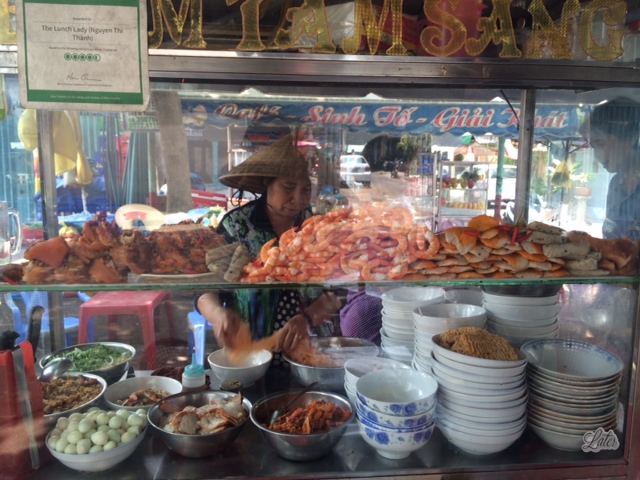
The "lunch lady" at work

The “lunch lady” at work

I should add: diners are happy to have their choices taken away, as long as that food is very good. On the day we arrived, there were thick, glassy rice noodles like glittery udon — what Thais would call guay jab yuan — in a lurid, Will Arnett-colored broth flavored with pork bone and chili. The soup held slices of fatty pork, deep-fried shallots, coriander, bits of fried pork rind, boiled quail eggs and cooked prawns, and the noodles were inevitably heavy and difficult to eat. This bowl was accompanied by both fresh and deep-fried spring rolls and an iced green drink that tasted like pennywort, or bai bua bok. Whatever they chose to plonk onto our table, we ate, and we enjoyed it.
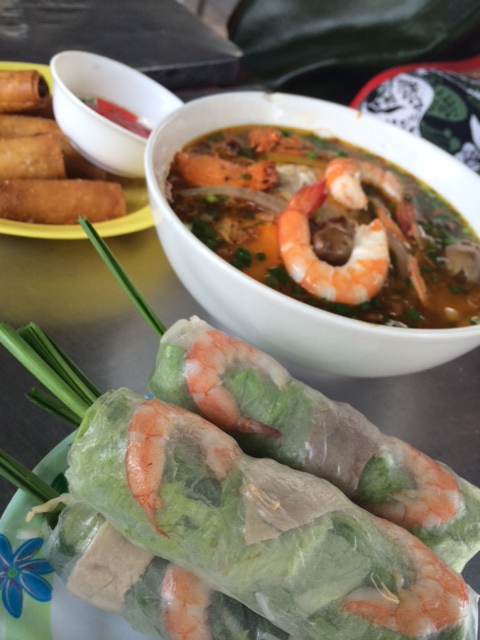
lunchfood

3 Comments

Filed under Uncategorized

Curry rice paradise

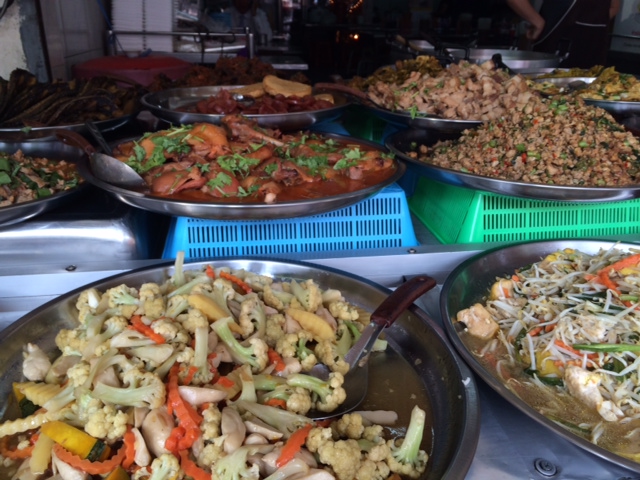
A selection of stir-fry dishes along the "khao gang" stretch of Thonglor Road

A selection of stir-fry dishes along the “khao gang” stretch of Thonglor Road

I always say I hate shopping, but that’s not true. I love shopping for food. I will happily use up the same amount of time usually spent staring at my phone on a couch at a Uniqlo somewhere, surfing through the aisles of a grocery store and looking through all the canned goods instead. You find out a lot about a place from the produce, condiments, and ready-made food on offer in its markets. And no question that food makes the best take-home souvenirs.

The raan khao gang, or “curry rice” stall, is the best approximation of the shopping experience that Thai street food has to offer. Vendors offer you a plate of rice (or, if you are in a southern Thai-type place, your choice of a plate of kanom jeen or fermented rice noodles) on which you have your choice of stir-fries, soups and curries with which to paint your blank, white “canvas”. I have usually seen a total of three toppings max, but theoretically, the sky is the limit. Sometimes, everything looks so wonderful that it’s easy to imagine having it all.

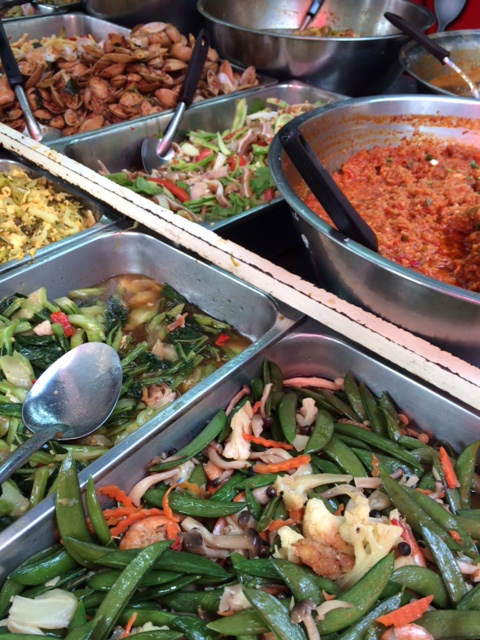
A selection of curries and soups at a Thonglor khao gang stall

A selection of curries and soups at a Thonglor khao gang stall

Which brings me to the stretch of street on Thonglor across from the police station labelled “Thonglor Pochana”. Sure, there is a Chinese-style rice porridge (joke) vendor and a great grilled pork collar (kor moo yang) guy and some nice-looking Chinese dumplings for sale if you get there early enough in the morning. But the real stars of this open-air block — the only block of this type left on a very expensive road, mind you — are the khao gang stalls who give pedestrians plenty to ogle on their way to work.

More stir-fries at a vendor on Thonglor

More stir-fries, deep-fried bits and chili dip at a vendor on Thonglor

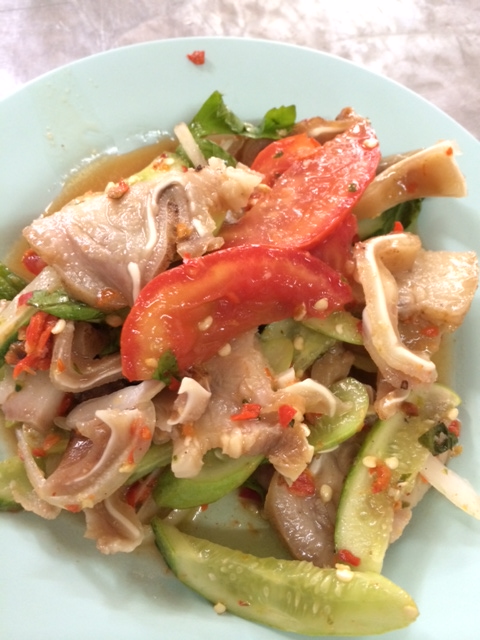
The thing that invariably reins me in is when I find something at a curry rice stall that I won’t usually find anything else: call it the “specialty of the house”. When I say “specialty of the house”, I mean that no matter the season or what’s on sale at the Klong Toey market, that one dish will be available, rain or shine. At the very decent one near me, the khao gang lady’s specialty is braised pig trotter on rice (khao ka moo). At the first of the three curry rice vendors at Thonglor Pochana (the one closest to Petchburi Road), the specialty is even harder to find: yum hoo moo, or a very serviceable pig ear salad.

Spicy pig ear salad on Thonglor

Spicy pig ear salad on Thonglor

This is a dish that always brings me back home, when my dad would get pig’s ears on the cheap from the local butcher, blanch them, and them toss them with some fish sauce, lime juice, sugar, coriander, onions and chilies and call it a day. Here, she tarts up her salad with some tomatoes, cucumber and spring onion, creating something a little more robust (and watery) — a nice counterpoint to all the spicy, greasy stuff elsewhere on display.

These ladies (because curry rice vendors are almost invariably ladies) start selling from 6 in the morning to when their food runs out (usually around 2 in the afternoon). In order to “shop” to your heart’s content, weekdays (when the morning commute is in full swing and office workers are looking for some cheap nosh) are your best bet.

Leave a comment

Filed under Uncategorized

What’s Cooking: Khao yum

Khao yum, pre-mix

Khao yum, pre-mix

I rarely talk music with other people. This is because most other people have terrible taste in music. I realize this is because people my age don’t have any time to trawl through iTunes looking for something they will really love, so content themselves with whatever it is that is playing on the radio right now. Usually, that is Taylor Swift, some teenager, or Taylor Swift.

When did it become a thing for middle-aged people to listen to One Direction? Or 5 Seconds of Summer? I’m talking grown-ass women and men. What happened? I mean, as long as U2 are still making albums, “old people music” will still exist. Arcade Fire, Black Keys: old people are still being marketed to! We have wallets too. It’s not a draconian world of Either/Or, where either you listen to Justin Bieber or you end up consigned to a dustbin of Air Supply and Kajagoogoo.

I’m sorry to say this, yet again, but this kind of stuff didn’t happen in my day. My dad wasn’t getting all up in my Duran Duran while I was growing up. My mom wasn’t drooling over Robert Smith and singing along to “Head on the Door” while doing the dishes. Come on now. Let’s resist shedding our old-fart identities, disintegrating into some mass-marketed stew of wannabe youth-dom, doomed to an ever-expanding wardrobe of Hot Topic, a cultural diet of Teen Wolf reruns and a never-ending trudge towards What Kids Are Doing Today. This, from the lady with the dyed mallrat hair.

My favorite Thai dishes are the ones in which each ingredient is free to sing clearly on its own merits. You can still identify each and every taste. This is why I love every type of yum, those spicy-tart salads that play with flavor and texture, and retro DIY snacks like mieng kum, which usually involves betel leaves and pairs them with an assortment of dried shrimp, flaked coconut, slivered peel-on lime, cubed ginger, sliced chilies, roasted peanuts and a gloppy sweet dipping sauce that manages to enhance rather than mask all the goodness underneath.

Another great dish that leaves the integrity of each ingredient intact? Khao yum, a Southern Thai mishmash of rice and painstakingly julienned herbs, fruits and vegetables, held together with generous lashings of nam budu, a Southern Thai fermented fish sauce used like a punctuation mark in many regional dishes. When Khun Nuraya, a Pattani-based artist, offered to show me how to make the only dish she ever bothers to cook, I naturally jumped at the chance.

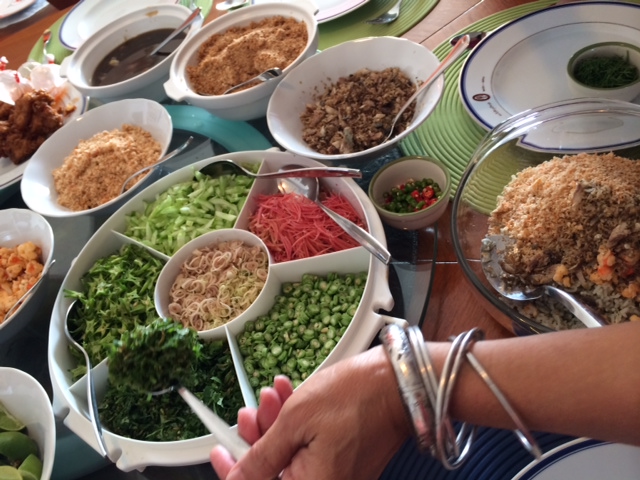
In the process of making the salad

Pattani in the house: In the process of making the salad

First off, khao yum requires a LOT of preparation. The prep work will dwarf the actual cooking of this dish, which only requires a little bit of mixing in a bowl. If you don’t live in Thailand, a few of these ingredients will be hard to come by. That’s when your imagination comes into play: as long as it’s tart and/or crunchy and relatively dry (we don’t want soggy rice), it should work. That means things like julienned green apple, asparagus, roasted peanut dust … the sky is the limit.

Ingredients (everything is to taste, so measurements are not set in stone. Also, you want to keep reserves of each ingredient on the side so that diners can add to their own taste. This should make about 4 portions):

— Nam bu du (a southern Thai fish sauce that Nuraya doctors by boiling it with lemongrass, palm sugar, lime leaves, galangal and onion. This can possibly be bought at a large Southeast Asian grocery store. If you are really in a jam, use regular fish sauce or nam pla rah)

nambudoo

— Fresh shrimp, about a handful, cleaned and deveined, then grilled and cut into bite-sized pieces

— Dried shrimp, about 1/4 cup, powdered (can substitute with powdered dried fish, or even peanuts if in a pinch)

— Coconut, about 1/3 cup, desiccated

— Lime, roughly one per person, either cubed with peel on or squeezed into the salad before eating

— Chilies, about a Tablespoonful, sliced

— Cucumber, 2 large, peeled and cut into inch-long shards

— Long beans, about a handful, cleaned and sliced

— Pai leaves (an aromatic herb that accompanies many Northern and Isaan larbs, maybe use shiso in a pinch)

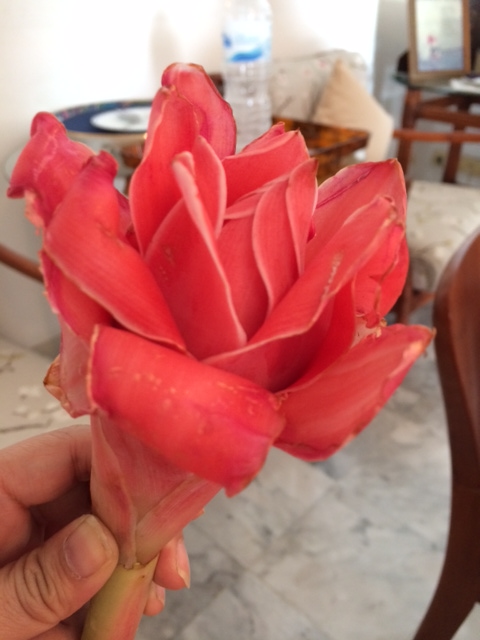
— Yeera blossoms (also referred to as dara. They look like this)

flower

— Winged beans, about a handful, sliced

— Lemongrass, sliced, bulb part only

— Lime leaves, chiffonaded

— Butterfly pea blossoms (optional)

— Pomelo, shredded (optional)

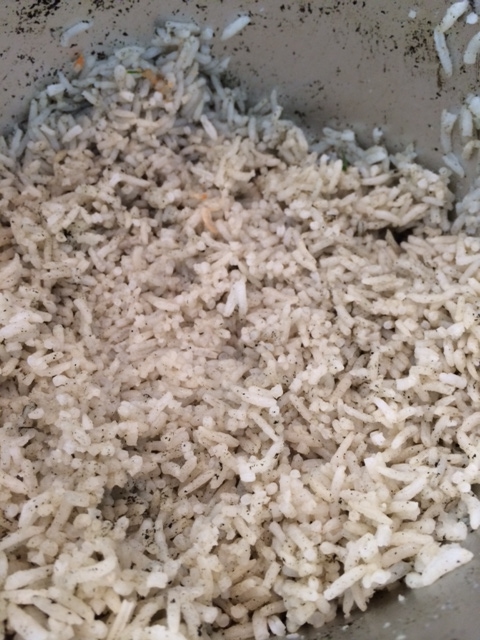
— Rice, mixed with pulverized bai yaw (also referred to as noni leaves, which are boiled, whizzed in a food processor, and then added to the rice cooking water)

noniThe rice will eventually look like this:

rice

Nuraya also adds small Thai mackerel that are pan-fried with lemongrass to rid it of its fishy scent, but a good substitute are dried small fish, which give the added bonus of adding a little texture.

Eventually, all of this is mixed together, but be prudent with the nam bu du if you don’t want a gigantic salad — you don’t want to tip the balance of flavors over in any way. The final product: a fresh, bright, light melange of ingredients that, instead of competing, manage to coexist peacefully without overshadowing anything else. In that way, one can say this dish is everything Thailand says it is.

A bite of the finished product

A bite of the finished product

4 Comments

Filed under Uncategorized