Duck noodle fans unite

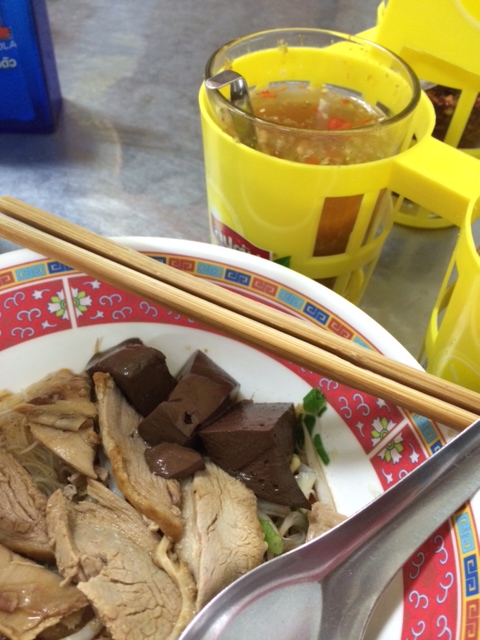
Duck noodles with the condiment tray at Guaythiew Ped on St. Louis Road

Duck noodles with the condiment tray at Guaythiew Ped on St. Louis Road

Karen likes to say that everything on the internet is “public, permanent, and traceable”. Everything, that is, except for my blog posts. I don’t know where my latest one is. I should probably be sad because I spent a lot of time on it. However, it might be God’s way of saying that no one should ever have to see my terrible Anthony Bourdain fan fiction. Bullet dodged, world.

I have been giving a lot more thought to fan fiction lately. This is because I want to make EL James-level bank, see my flaccid scribblings re-enacted on the big screen, and then make a nuisance of myself at numerous, famous people-populated parties. I have narrowed the criteria down to three major points. To write successful fan fiction, one must: 1.) feature a love triangle 2.) have the heroine (who is invariably the narrator and unwitting object of everyone’s affections) possess some ineffable quality that is completely beyond her control and renders her irresistible to her more standoffish (and undoubtedly more handsome) suitor, and 3.) make the heroine dowdy and/or judgmental, because making an effort to look good/being popular with boys makes you a big slut. She must be attractive to every man in the story for some other reason, as long as that reason is not her personality or intelligence, because that is boring and/or hard to write.

There seems to be a set of criteria for the successful Thai food stall as well. These are: 1.) tables that are crowded with “locals” 2.) a gruesome display of animal carcasses either in front or in back, because one must always be reminded of how truly adventurous one really is, and 3.) an abusive and/or harried cook. If the cook is not sufficiently ornery, then the stall must be in a hard-to-find location. The point is to suffer for your food.

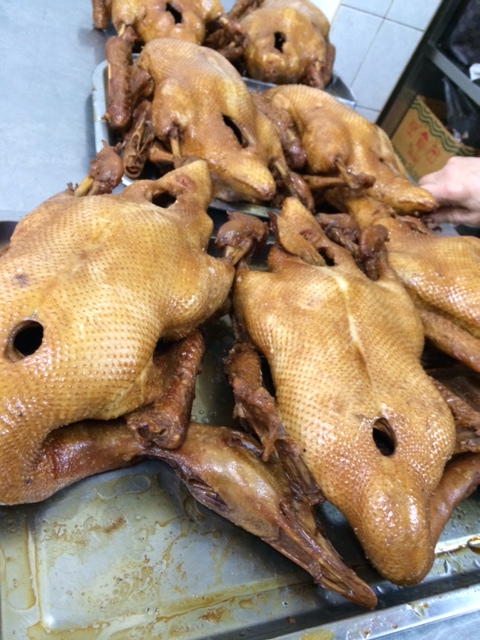
Luckily for me, Guaythiew Ped on St. Louis Road (127/44 St. Louis Soi 3, 02-211-1411) fulfills all of these criteria, from the grisly-yet-tasty carcasses:

Ducks ready for the noodle bowl

Ducks ready for the noodle bowl

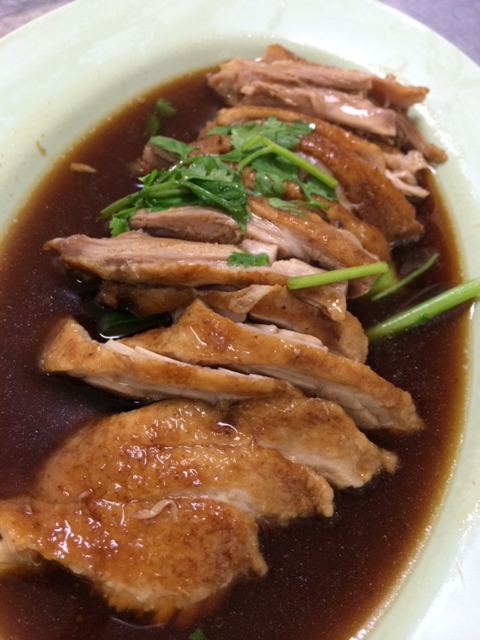
to the crowded tables and harried, frantic cook out in front. Of course, the food stands center stage — yes, the duck in every iteration: its tender gizzards, simmered feet, soft neck, rich liver and tranches of soft meat, cut with a vinegary chili sauce to offset the greasiness of the flesh.

Duck meat without the noodles

Duck meat without the noodles

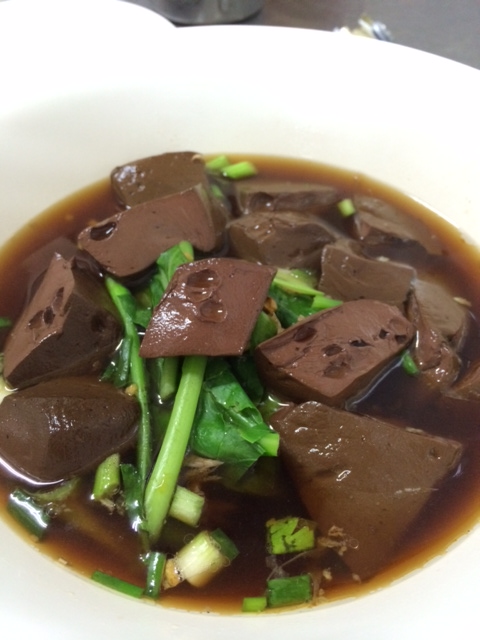
But my favorite part of my meal is the cubed duck’s blood, not so soft that it disappears into the broth, nor so hard that it resembles sanguinary finger jello: slightly squidgy and giving to the slightest pressure, festooned with spring onions and coriander leaves.

A bowl of duck's blood

A bowl of duck’s blood

Presented with a formidable pile of the stuff, I managed to dispatch of every duck blood cube in maybe 5 minutes.

“You ate that like a vampire,” said Karen, unable to try even a single cube, because I had eaten it all.

2 Comments

Filed under Uncategorized

The Beauty in Bitterness

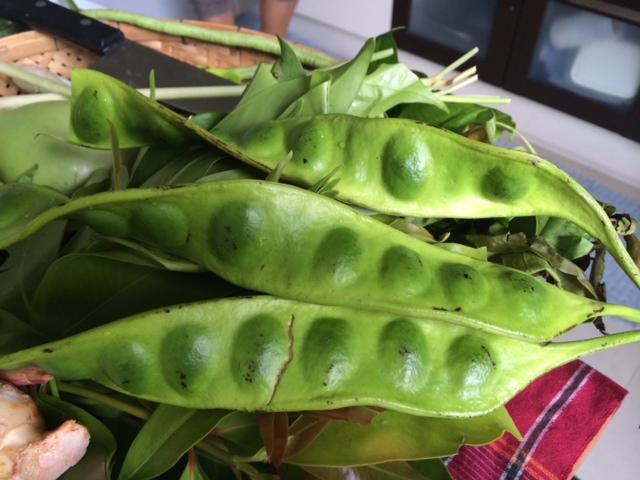
Sator -- or stink beans, a famously bitter Southeast Asian ingredient

Sator — or stink beans, a famously bitter Southeast Asian ingredient

His name was Aharon. He was very smart, cute, enormously funny, and had great hair, a dark mass of curls. I harbored a crush on this poor boy for what felt like years, but was probably only months. For weeks and weeks, I blathered on to anyone who would listen about my crush on this innocent person, who had not done anything to anyone, in the same way I had bored my fifth-grade lunch table mates with stories about Michael Jackson’s daily workout routine, or how John Taylor’s favorite meal was breakfast. So it was inevitable that one of those friends would take revenge on me by actually telling the object of my affections how I really felt about him.

It was, as Karen likes to say, a sixth-grade nightmare. There is nothing worse than having your secret crush discover the audacity of your affection for him — as if you actually had a CHANCE, as if something like this could even fall within the realm of possibility. The weight of my presumption was made worse by the knowledge that he would be kind, and would not make fun of me or emit “ewww” noises like an actual sixth-grader.  He would be nice. He might even have deigned to give me hope. But that only made it worse. The fact is that someone’s affection for you, even if unreturned, leaves a terrible yoke of obligation that can either be shrugged off gracefully, severed cruelly, or borne patiently. I was sure he would have been patient. But I did not want to be present at anyone’s pity party if I was going to be the guest of honor.

I responded as one would when it is 1995 (e.g. running home and listening to Jeff Buckley’s “Last Goodbye”. We didn’t have Adele in those days). I also decided to tell him that I most definitely did NOT have feelings for him. I mean, I was going to lie. This would relieve him of the burden of having to pretend anything with me, and we could continue to at least be friends. Sixth-grade nightmare averted. So I knocked on his door and that is what I did. He never really spoke to me again.

A male friend of mine, when told this story (I am still boring people with my stupid stories, 30 years later. Welcome to my blog) said I had humiliated my crush. This, when I thought I was doing him a favor. The thought that I would miscalculate to the extent of causing this person actual distress represents a low point in my romantic life. Don’t get me wrong — as all of my ex-boyfriends would attest, there are many, many low points in my romantic life. But this is the one I remember most.

Low points are an inevitability in life. In fact, they are a necessity. Who walks downhill all the time? You need to climb uphill in order to get to that point. They provide the contrast with which the high points can be truly appreciated. Do you know who understand this? You’ll never guess.

Thai cooks are known to understand this. They are able to use low points — bitterness — in ways that manage to amplify the high notes to make them that much more dramatic, like the way blanched bitter gourd is served alongside a tamarind chili dip, or sadao (a Thai riverside herb) offsets grilled snakehead fish with sweet tamarind sauce. They provide the oomph against which the freshness of certain ingredients can be highlighted, like the thin shavings of raw bitter melon in goong cha nam pla, or raw  shrimp marinated in fish sauce. And they lend gravitas and heft to certain dishes, emphasizing meatiness, warmth and substance, like in larb muang, the Northern Thai minced pork salad. Indeed, of all the regions, it is perhaps the Northern Thais who accentuate bitter flavors the most, since bitterness figures prominently in their cooking: echoed in the flavors of the North’s many fresh herbs and leaves, or in the animal bile that figures so prominently in their meat dishes. Bitterness is a major component in the Northern Thai flavor profile, a deep, dark thrum against which salt, chili and animal fat can play.

It’s a common misperception that, to make something more authentically Thai, one simply has to dial up the spice to 11. I don’t find that to be true of either central or northern Thai cuisine. Thailand, as any long-term expat can tell you, is never that easy to work out. Instead, to make something more Thai, all the flavor facets — sweet, salt, sour, spicy, bitter — have to be represented and balanced. Sadly, this is becoming less of an imperative, even in dishes where it figures importantly, like in gaeng jued mara yad sai (bitter melon stuffed with pork and stewed in a pork bone broth). This is because the Thai palate is changing to reflect globalized tastes: becoming sweeter, saltier, spicier. In other words, more amped, more MSG’d. What this means is that dishes are actually changing, leaving out the bitter melon in goong cha nam pla or threatened with extinction, like sadao nam pla wan (Thai river herb with grilled fish and sweet tamarind sauce).

This results in the nature of Thai food changing. And no, it’s not because of farang chefs, or McDonald’s, or the media, or anything that people like to blame when things change. It was simply a matter of time. Low points — at least in food — have been swapped out for a vista of downhill rambles, a glossy world of ease and convenience where everything is a quick, Rot Dee-assisted stir-fry away from the table. But bereft of our culinary sixth-grade nightmares, how will we appreciate life’s occasional sweets?

Kua kling with fresh stink bean, courtesy of @chilipastetour

Kua kling with fresh stink bean, courtesy of @chilipastetour

3 Comments

Filed under Uncategorized

A day with Worapa

The finished product: our kanom yodmanee, under Khun Worapa's direction

The finished product: our kanom yokmanee, under Khun Worapa’s direction

Chin (www.foodtoursbangkok.com) is always full of surprises. A lot of the time, those surprises involve exerting oneself via a long, brisk walk and some elbow grease, so I always try to psyche myself up before our next excursion. This isn’t because days out with Chin are an ordeal. It’s because I need to hide the fact I am terribly lazy and would prefer to burrow myself into the faux-leather confines of my mother-in-law’s hand-me-down couch, pretending to watch “Outlander” for all the historical information on Jacobite Scotland, and not for a reason that rhymes with “Shmamie Shmaser’s shmass”.

But I’m excited for today, because @karenblumberg is with me and the surprise du jour involves trekking out to Samut Songkhram, where we will learn how to make a Thai dessert known as kanom yokmanee — “bundles” of cooked pearl tapioca flavored with pandanus leaf extract and rolled in fresh coconut flesh. Before we get there, however, we stop off at “Thalad Rom Hoop” at Maeklong, so named because an honest-go-God train runs through the center of the marketplace about four times a day. This necessitates display tables on retractable rollers and awnings that can be pulled back, hence the market’s name.

When the market is not busy hiding from the wrath of an onrushing train (that is traveling at roughly 5 mph), it is busy selling the stuff that most Thai wet markets sell, like the famously delicious Thai mackerel:

Steamed pla tu Maeklong

Steamed pla tu Maeklong

And offbeat snacks that I mistake for fish meatballs, like these rolled-up balls of potato and coconut, grilled just enough to form a thin crust over a fluffy, soft center like a sweetened, globe-shaped French fry:

Mun tip on the outskirts of the market

Mun tip on the outskirts of the market

But gradually, it becomes time to finally head over chez de Khun Worapa, a Thai cook whom Chin discovered after sampling some of her wares at a nearby temple. Thai desserts are often a tricky proposition because they sometimes manage to incorporate a jarring, almost metallic sweetness that tends to set teeth on edge. Unfortunately, this becomes the only thing that people remember of them, instead of the fresh ingredients and old-fashioned methods of preparation (usually steaming and boiling, if they are old-fashioned central Thai sweets). Worapa’s desserts, however, come from 100 percent natural ingredients — most from her own garden — and as a result, bear natural, almost muted flavors and a delicate balance of sweet-salty that is the standard signature of any true Thai dessert.

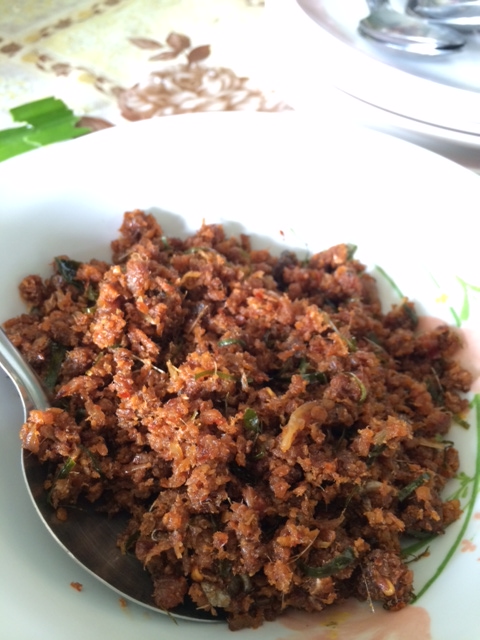
Before we cook, though, we have to eat. Luckily for us, Khun Worapa has lunch covered, too, setting out a jungle curry flavored with fish entrails and Thai eggplant, a sour curry of maroom, a type of thick-skinned gourd broken open to reveal a soft, custardy flesh meant to be scraped from the peel like an artichoke leaf, and this flaked fish stir-fry that Worapa assures us is made entirely of fish, instead of being bulked up by breadcrumbs like at other vendors’:


Flaked fish stirfry with chili paste and lime leaf

Flaked fish stirfry with chili paste and lime leaf

Like any good cook, Worapa has control freak tendencies. This becomes obvious once she starts critiquing our eating technique (“Why are you piling everything on your plate at once? Why don’t you try everything one at a time? Your food isn’t going anywhere!” and “Why don’t you sit up straight? You will be able to fit more food into your stomach if you don’t slouch!”), but her friendly patter only enhances the dining experience, because we love being bossed around as long as it comes from a Thai person who cooks good grub.

Alas, the time to put us to work draws near and we begin to slow down. Karen confesses she is nervous, because we have just learned we will have to stir the tapioca mixture in a copper pot over the stove for a full hour in order to get it to the proper consistency. What kind of consistency? Think super glue, but stronger — something you can build a brick wall with. Worapa says this kind of back-breaking labor forms the heart of all Thai dessert-making: “The ingredients are cheap,” she says. “It’s the labor that makes up the value of a dessert.”

But I’m getting ahead of myself: first, you have to make the tapioca mixture. It’s a package of tapioca, mixed with 2 glasses of pandanus leaf juice (squeezed from a handful of julienned leaves that are steamed), a glass of coconut water, and 3 glasses of rose water steeped overnight from Worapa’s own pesticide-free roses (in summer, Worapa advises using jasmine instead):

Rosewater with steamed coconut flesh in the background

Rosewater with steamed coconut flesh in the background

This mix is earmarked for the copper pot, which conducts heat more evenly and acts as extra insurance from burning.  We take turns stirring this big pot of green, which is quickly taking on the appearance of Ghostbusters slime. Those of us not stirring our arms off are set to work on yet another backbreaking job, scraping gobs of shredded flesh from halved coconut shells:

Getting to work

Getting to work

Worapa has opinions on both work fronts: “Shave from the rim!” she instructs Chin, before telling me how I should place my hands on the wooden paddle as I stir. All of this must work, because before long we have a pot full of a thick, heavy, glutinous green mass and two trays full of coconut shavings to steam (steamed coconut keeps for longer than the fresh kind). After only 50 minutes (!), the tapioca is ready to be poured out and cooled, before it is hand-rolled and covered in coconut.
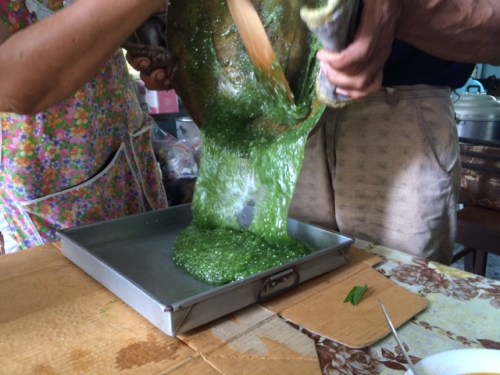
Pouring the tapioca out to cool

Pouring the tapioca out to cool

The taste is as it should be: slightly sweet, salty from the coconut and fragrant with the smell of pandanus and rose. We go home with our newly-made candies sticky in our bags and our bellies bulging with food, and we fall asleep in the car with our hands smelling of fresh leaves.

To learn more about cooking with Worapa, contact Chin of Chili Paste Tour at chilipastetour@gmail.com.
2 Comments

Filed under Asia, Bangkok, dessert, food, food stalls, Thailand