In praise of the porky

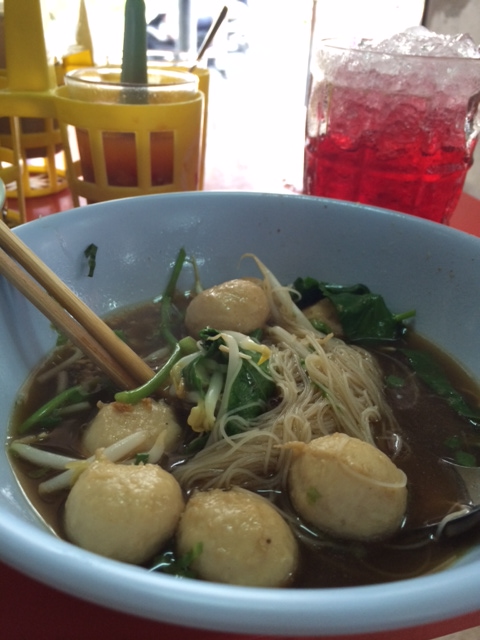
Rice vermicelli in pork broth with meatballs at Wor Rasamee

Rice vermicelli in pork broth with meatballs at Wor Rasamee

No one wants to be a pig. The very worst thing one can do is to eat like one, squeal like one, or sweat like one. Don’t even think about looking like one. That is the worst that bad can get.

But when cooked over a grill, crisped and sliced over a mound of fluffy white rice or minced and folded into an omelet, the pig becomes something that every Thai food lover wants a part of. Few dishes demonstrate this more than guaythiew moo, or pork noodles: a mix of pork meatballs, minced pork, stewed fatty pork and pork liver, simmered gently in a pork broth before a quick dunk in a plastic bowl with a handful of rice noodles, some blanched bitter greens, and a sprinkling of bean sprouts and deep-fried garlic bits.

Because many Thais refrain from eating beef for religious reasons — as followers of “Mae Kwan Im” (a Mahayana Buddhist Goddess of Compassion now popular among many Thai-Chinese Theravada Buddhists), they are encouraged to cut out beef in view of eventually going vegetarian — pork noodle joints are probably the most numerous of all the noodle vendor varieties scattered throughout the city. This means there is tons of competition, and more pressure to set oneself apart from the rest of the noodling fray (I’m not counting bamee, or egg noodles, with the rest of the pork noodle crowd because the emphasis there tends to be on the noodles and the toppings are different — that said, there’s lots of competition there too).

Some vendors bomb the crap out of your tastebuds with a plethora of chilis, and some are nam tok specialists who add a touch a pork blood to their broth. It’s the rare vendor who lets the pig stand on its own porky merits. That is Wor Rasamee (corner of Silom and Saladaeng roads), a longtime pork noodle shop run by a deeply efficient elderly man who is the Thai street food equivalent of Rene Lasserre. Every need is fulfilled quickly and with as little drama as possible, sometimes before you have even thought of it. And the time it takes for a bowl to get to your table? 10-15 seconds, tops. Really.

Not to say there’s no little gimmick to set this little stall apart. Here, it’s the unique sauce, set atop every table and served alongside the four-pronged usual condiment selection of sugar, chili flakes, chili-studded white vinegar and fish sauce. It has no name, but it does have ingredients: vinegar, garlic, chilies, palm sugar, and an irresistible hit of fermented tofu, my culinary Achilles heel, a quicksilver sweetness in a pork broth smelling faintly of Chinese 5-spice powder.

sauce

How can I say no? It is food crack. There are surely more ingredients in this sauce than were relayed to me, and I will try to spend the next few weeks ferreting them out. Until then, I will have to risk heading back to this crowded, busy neighborhood in the heart of the central business district in the hopes of snagging a seat in the midst of all the Japanese tart cafes and fast food chains.
4 Comments

Filed under Asia, Bangkok, food, food stalls, noodles, pork, Thailand

Northern Thai sausage kings

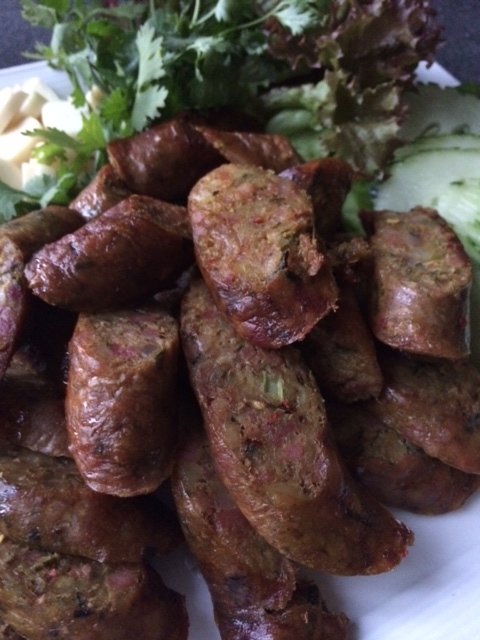
Grilled northern Thai sausages from Sai Oua Pa Nong in Chiang Rai

Grilled northern Thai sausages from Sai Oua Pa Nong in Chiang Rai

Everyone has a secret superpower, and I am no different. Some people are wonderful dancers. Some people can catch anything that is thrown at them. Some people can multiply large sums in their heads. And me? I can clear a 3-foot radius around me in about 10-15 minutes without even trying. When I tell people about this, they shake their heads and think, She’s at it again. Exaggerating her uselessness. But they’re not around to see it. I can guarantee that, if I sit on one side of a room before yoga class, everyone else will try to sit on the other side. At a large dining table, if no one is assigning seats and no one really knows me very well, one or both chairs to either side of me will remain empty. I have even had people switch seats at a movie theater in Thailand — where there is assigned seating — to move to an empty seat further away from me. I don’t know if it’s my smell or what. It certainly isn’t something I do on purpose. And it is almost never useful. It’s just something that happens, more often than not.

It’s a shame my secret superpower isn’t something useful, like languages. I am ashamed to say it, but I only have room in my head for 1.5 languages, as full as it is of Game of Thrones trivia and a detailed chronology of Jack White’s past haircuts. As you might have guessed, English makes up one of those languages. The other 0.5 is up to where I am living at any point in time. It used to be French, when I was studying cooking in Paris. Then it was Japanese, when I was working as a financial reporter in Tokyo. Now it is Thai, my “native” language, which makes it all the more pathetic when I open my mouth to order a meal or give directions or make small talk — whatever it is that people do to wile away the time until you get to go to sleep. People will frown and say, “Where are you from?” And I will smile and say, “The Philippines.”

Sometimes. Just sometimes. Other times I have to go into the whole rigamarole of how I moved to the States when I was a baby and came back and blah blah blah blah. It is the penalty that life exacts for speaking such terrible Thai. So it is no surprise when I find myself with a spare 10 minutes in Chiang Rai (the town of my birth) and head over to Sai Oua Pa Nong  (San Kong Noi Road, across from Chetupon Temple, 082-760-4813) for what a few locals said were the best sai oua (Northern Thai sausages) in town. That is hard for me to believe because 1.) the best Northern Thai cook I know is my Aunt Priew, who lives in Chiang Rai and 2.) I make my own sai oua too, and it is not bad. It might even be good, if you are my friend and you just spent an entire afternoon making sausages with me.

The minute I get there and ask for “50 baht of sausage” in Thai, the man in front waiting for his own sausage order to be grilled narrows his eyes at me. “Where are you from?” he says, and I’m still thinking if I should choose “Filipino” or “Japanese” when a sprightly little old lady carrying what looks like 1000 baht worth of sausages looks up at me and grins.

“Can I just get a little bit of this sausage?” I say. “I just want one or two bites,” and she says “Certainly!” with a great big smile.

“And what’s this?” I ask, pointing at a bunch of small plastic baggies filled with a thick green liquid.

“It’s nam prik nam pak (vegetable juice chili dip),” she says. “You should get it, it’s very good.”

I run over the rest of the menu with her, asking for recommendations and whatnot and it’s only when she turns to leave do I realize that this lady is a freaking customer and I’ve been running my mouth at the wrong person for something like 10 minutes.

“The smallest order of sausages for takeaway is 150 baht,” says a 20something man behind the counter.

“Do you work here?” I ask. He may or he may not, but he throws in the vegetable juice chili dip for free, just so I can try it out.

It turns out the sausages are thick, closely-packed and meaty, peppered liberally with big melting chunks of pig fat. They taste like they’re supposed to, salty and herbal but with a generous kick of chili spice, so I get why people like them. The real revelation, though, is the chili dip, which is fibrous and green, yes, tasting just like Claussen dill pickle juice. I love it.

9 Comments

Filed under Asia, food, food stalls, Northern Thai, pork, Thailand

Glutton Abroad: Weathering the holiday season in Germany

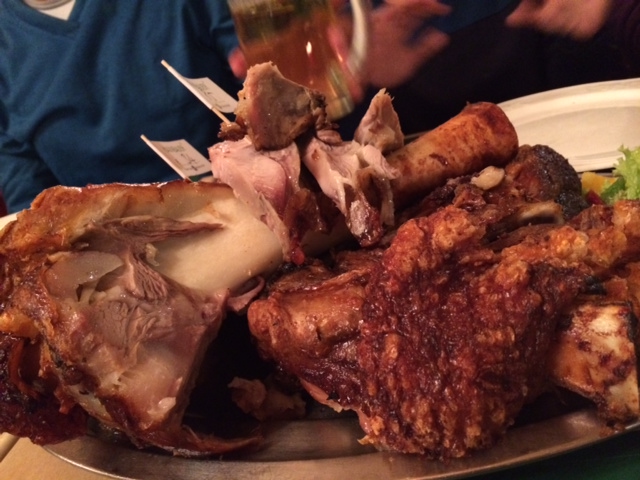
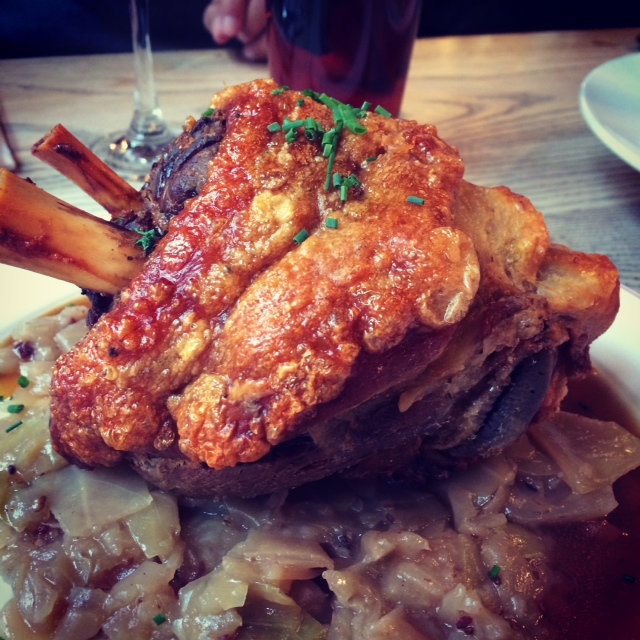
Deep-fried pork knuckle atop a mound of cooked cabbage at Augustiner brau Munchen in Berlin

Deep-fried pork knuckle atop a mound of cooked cabbage at Augustiner brau Munchen in Berlin

The only reason I go anywhere is for the food. I don’t think this should come as a surprise to anyone. It really is my only requirement. I mean, everyone has their “thing”: some people need bathrooms in their hotel rooms, or to see the most popular sights, or to get a proper grounding in the local history. I do not require even that. My only desire is to be properly fed, and by proper I don’t even mean for the food to be served on nice plates, in pleasant surroundings with decent servers. I mean the food must be proper. It must be cooked with some semblance of sincerity and even pride. It must say, I did this for you to enjoy, I did this just for you because I think it is good. Treat it accordingly. It’s one of the biggest acts of generosity, to do this for someone you don’t know and might not even like if you did.

Food that is meant for tourists doesn’t always say that. Sometimes it says, I just need to get through this shift. Four more covers and I’m done. Get out of my face as quickly as you can. Please. It seems to be the attitude that underlies a lot of the street food still in parts of the West, as something made with haste for people who don’t know any better and are in a hurry themselves. Food as fuel, eaten to live. That kind of food, I would rather not eat. To some, it makes me a difficult traveling companion.

Take the German Christmas market as an example. Full of people, food, drink and games, it would seem like the ideal place to take anyone with even an inkling of some joie de vivre.  For my part, I thought the Christmas market would be like Aor Tor Kor, but cold and with Christians. It turned out to be more like the Suan Lum Night Bazaar. And while that pleases most, normal people — tourists and Germans alike — there are only so many cups of gluhwein and eggnog to slog through, so many sausages in hot dog buns to consume, so many bites of flammkuchen and langos slathered in ham, cheese and sour cream to take before it all becomes an indiscriminate blur of sameness, all folded neatly under an all-encompassing cloak of German-ness. The culinary boundaries to Brandenburg, Thuringia, Bavaria all become blurred. This is what all Germans are, it says. Don’t look any further. It’s the same thing that Thais do: hiding behind the gilt-edged screen of culture, religion, green curry and smiles. You don’t have to work any harder, it all says. This is as far as you go.

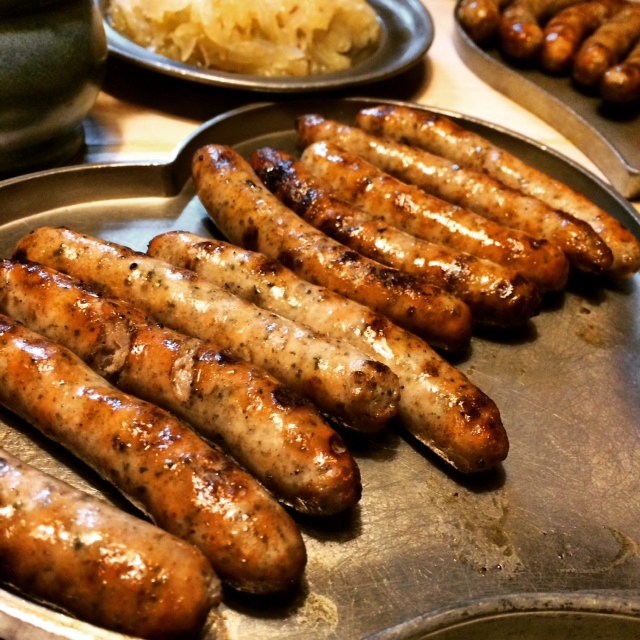
A globally-beloved favorite: Nuremberg sausages at the Bratwurst House in Nuremberg

A globally-beloved favorite: Nuremberg sausages at the Bratwurst House in Nuremberg

It got me thinking about the tourist restaurant experience. To my mind, Bavaria is the German equivalent of Cantonese cuisine: the region from which the country’s most popular culinary exports hail. Everyone with even a passing knowledge of German food knows the sausages, the sauerkraut, the deep-fried pork knuckle, the potato soup and the light-as-a-feather dumplings that adorn every platter on every table ever set in the shadow of an Oktoberfest sign. It’s also the food that appears on nearly every “traditional German” restaurant on the road, from Berlin to Munich. One would think that this food is what all Germans eat, everywhere, regardless of whether they live in Stuttgart or Dresden.

Thai restaurant menus are the same — even in Thailand. While regional specialists shilling Isaan or Northern Thai do exist, it’s the rare Thai restaurant that is brave enough to leave off central Thai favorites like green curry, because that is what most people definitely like. It’s like presenting your best face to strangers at a party. Everyone sees your best face — your pad thai, your tom yum soup. It’s only the people who really want to who get to go further. Some day, I am hoping to return to Germany to get a peek at what’s underneath that mixed sausage platter.

Both veal and pork knuckles at Haxnbauer in Munich

Both veal and pork knuckles at Haxnbauer in Munich

4 Comments

Filed under Uncategorized